
Following further discussions with industry representatives on stringent prevention protocols, and after advice from scientists and consultation with Premiers, Cabinet has decided to ease restrictions on certain other economic activities.
These activities include:
• Restaurants for ‘sit-down’ meals
• Accredited and licensed accommodation, with the exception of home sharing accommodation like Air BnB.
• Conferences and meetings for business purposes and in line with restrictions on public gatherings.
• Cinemas and theatres, to be aligned to limitations on the gathering of people.Casinos.
• Personal care services, including hairdressers and beauty services
• Non-contact sports such as golf, tennis, cricket and others. Contact sports will be allowed only for training and modified activities with restricted use of facilities.
In each instance, specific and stringent safety requirements have been agreed on and will need to be put in place before a business can re-open, and protocols will need to be strictly adhered to for businesses to remain open.
Announcements will be made in due course to detail these measures and indicate the date from which these activities will be permitted.
We have taken this decision with due care and seriousness, appreciating the risks associated with each activity and the measures needed to manage those risks.
Altogether, these industries employed over 500,000 people before the lockdown. We have had to think about these people and those who depend on them for their livelihoods. Through the easing of the lockdown we are continuing to balance our overriding objective of saving lives and preserving livelihoods.
It is important to remember that this is a global pandemic and that most countries are facing similar challenges and must resolve similar dilemmas.
We are therefore working closely with international agencies and other countries in responding to the coronavirus.
As Chair of the African Union, we are integrally involved in forging a common approach across the continent, ensuring that we mobilise resources and develop strategies to ensure that no country is left behind.
There are currently over 250,000 confirmed cases in Africa and there have been more than 6,700 deaths.
This is relatively low compared to the global number of cases – which has now passed 8 million largely because African countries acted swiftly to implement national lockdowns.
However, we can expect infections in Africa to rise as countries ease restrictions in the face of severe economic pressures and we are working together as a continent to meet that challenge.
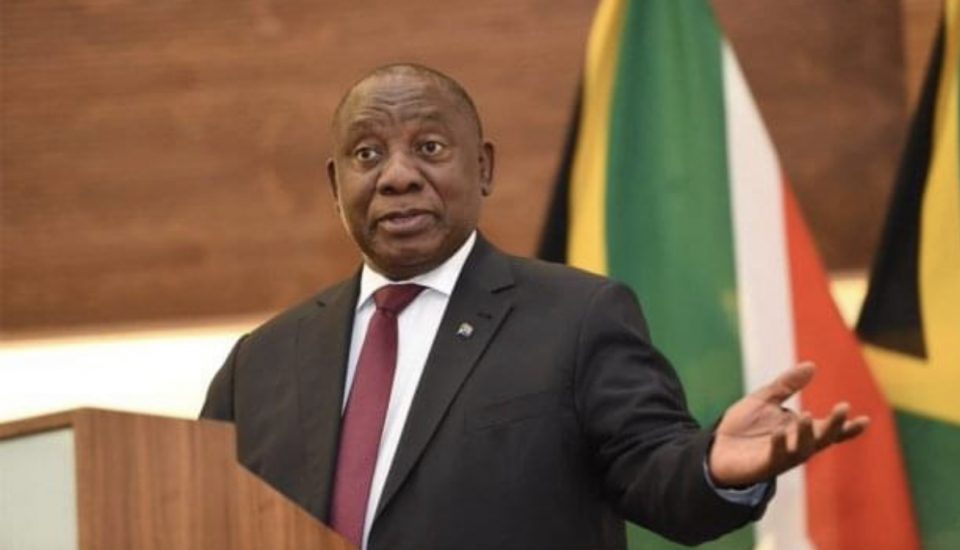
Snippets of President Cyril Ramaphosa’s Address on South Africa’s Response To Covid-19
It has been particularly important for us to open up personal care services, because this is an
industry that predominantly employs women.
The last three months have been particularly difficult for the millions of women who work as
hairdressers, in spas, as therapists and technicians. Many of these are businesses are owned by women and a source of income in the informal sector. Giving women the necessary support to become financially independent is the greatest of priorities, especially now.
On Gender Based Violence It is with the heaviest of hearts that I stand before the women and girls of South Africa this evening to talk about another pandemic that is raging in our country – the killing of women and children by the men of our country.
As a man, as a husband and as a father, I am appalled at what is no less than a war being waged against the women and children of our country. At a time when the pandemic has left us all feeling vulnerable and uncertain, violence is being unleashed on women and children with a brutality that defies comprehension.
These rapists and killers walk among us. They are in our communities. They are our fathers, our brothers, our sons and our friends; violent men with utterly no regard for the sanctity of human life.
Over the past few weeks no fewer than 21 women and children have been murdered. Their killers thought they could silence them. But we will not forget them and we will speak for them where they cannot.
We will speak for Tshegofatso Pule, Naledi Phangindawo, Nompumelelo Tshaka, Nomfazi Gabada, Nwabisa Mgwandela, Altecia Kortjie and Lindelwa Peni, all young women who were killed by men.
We will speak for the 89-year-old grandmother who was killed in an old age home in Queenstown, the 79-year-old grandmother who was killed in Brakpan and the elderly woman who was raped in KwaSwayimane in KwaZulu-Natal.
We will speak for the innocent souls of Tshegofatso Pule’s unborn daughter who had already been given a name, six-year-old Raynecia Kotjie and the six-year-old child found dead in the veld in KwaZulu-Natal. They are not just statistics.
They have names and they had families and friends. This evening, our thoughts and prayers are with them.
I want to commend the South African Police Service for their excellent work in arresting almost all of the alleged perpetrators.
As these suspects make bail applications this week, I have the utmost confidence that our courts will send the strongest of signals that such violence has no place in society.
At a joint sitting of Parliament in September last year, I announced an Emergency Response Plan to combat gender-based violence and femicide and that R1.6 billion in government funding would be reprioritised to support its implementation until the end of the financial year.
We now have a National Strategic Plan to guide our country’s national effort against gender- based violence.
During the lockdown period we have ensured that survivors of gender-based violence have access to support and services, including the GBV hotline, shelters and centres providing support to victims of sexual violence.
Since December last year, 10 government-owned buildings have been handed over to the
Department of Social Development to be used as shelters, addressing one of the biggest
challenges facing survivors who want to leave abusive relationships.
Over the last 18 months, we have made demonstrable progress in broadening access to support for survivors.
Thirteen regional courts have been upgraded into sexual offences courts. To support the work of law-enforcement, 7,000 evidence collection kits have been distributed regularly to every police station in the country and there are now over 1,000 survivor friendly rooms at police stations.
Many police, prosecutors, magistrates and policymakers have undergone sensitivity and awareness training, and over 3,000 government employees who work with children and mentally disabled persons have been checked against the National Register of Sex Offenders.
Legislative amendments have been prepared around, among other things, minimum sentencing in cases of gender-based violence, bail conditions for suspects, and greater protection for women who are victims of intimate partner violence. I urge our lawmakers in Parliament to process them without delay.
Our courts have been firm in dealing with cases of gender-based violence even during the
lockdown period, handing down life sentences and multiple life sentences to perpetrators.
I want to assure the women and children of South Africa that our criminal justice system will
remain focused on gender-based violence cases and that we can expect more arrests and more prosecutions against perpetrators to follow.
The perpetrators of violence against women and children must receive sentences that fit the
horrific crimes they commit. It is deeply disturbing that the spike in crimes against women and children has coincided with the easing of the coronavirus lockdown.
According to the police, violent crime – especially murders and attempted murders – has increased since alert level 3 took effect on 1 June. Cases of abuse of women and children have also increased dramatically.
We need to ask some very difficult questions of ourselves as a society.
In particular, we need to examine the effect of alcohol abuse not only on levels of violence, but also on road accidents and reckless behaviour.
Several international and domestic studies showclear linkages between alcohol abuse and gender-based violence Of course, it is not alcohol that rapes or kills a woman or a child. Rather, it is the actions of violent
men. But if alcohol intoxication is contributing to these crimes, then it must be addressed with
urgency.
We need to draw the lessons from this lockdown and decide how we can protect our society from
the abuse of alcohol. Certainly, we need to provide greater support to people with drinking
problems, including through rehabilitation and treatment.
We need to encourage responsible drinking, especially among young people. We need to be tough on liquor outlets that violate the terms of their licenses and who sell alcohol to those under-age.
But we will also need to look at further, more drastic measures to curb the abuse of alcohol
Ultimately, the success of our fight to end gender-based violence will require the involvement and support of our entire society.
If we are serious about ending these crimes, we cannot remain silent any longer. These perpetrators are known to us and our communities.
By looking away, by discouraging victims from laying charges, by shaming women for their lifestyle choices or their style of dress, we become complicit in these crimes.
I once again call on every single South African listening this evening to consider the consequence of their silence.
As a country, we find ourselves in the midst of not one, but two, devastating epidemics. Although very different in their nature and cause, they can both be overcome – if we work together, if we each take personal responsibility for our actions and if we each take care of each other
The road ahead will be long and difficult. The task of recovery will be considerable. But if there is anything that we have learnt in the last 100 days, it is that we are a resilient, resourceful and determined people.
We shall overcome.
May God bless South Africa and protect her people. I thank you.
