
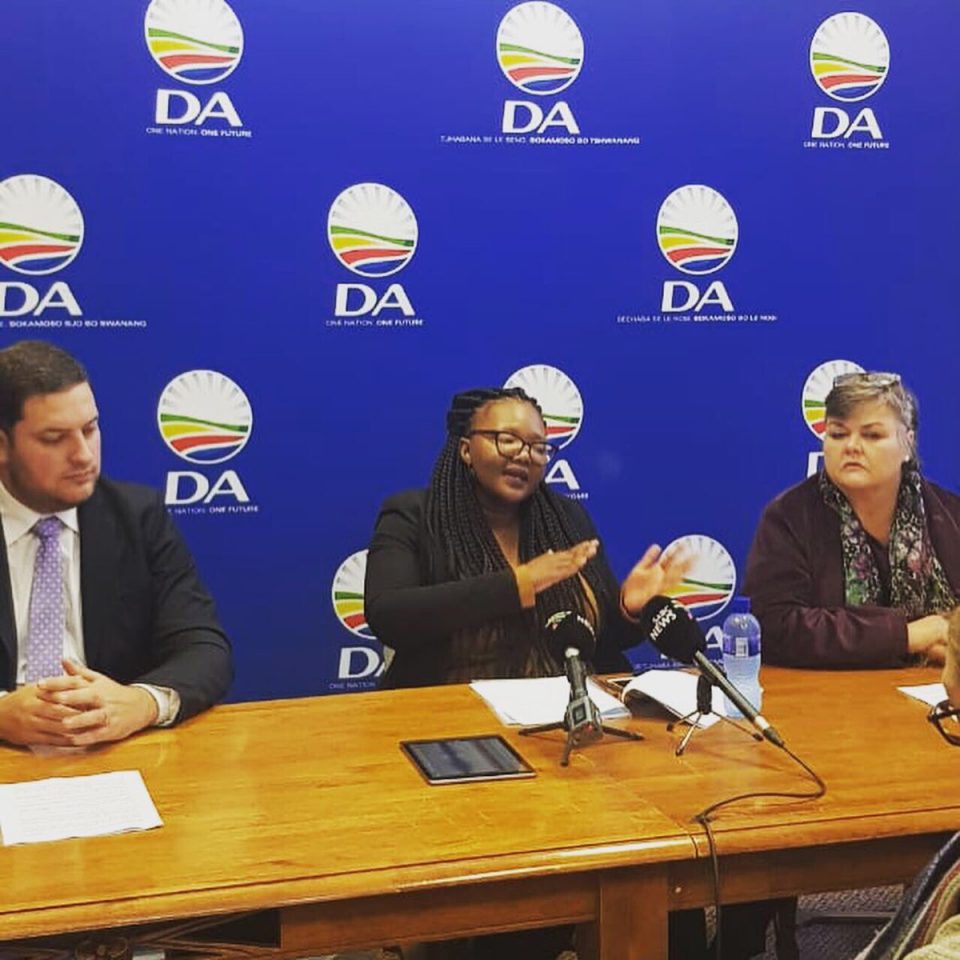
The global trend in the public health is to move towards providing universal health care. “It is crucial that South Africa follows suit”, Siviwe Gwarube MP – DA Shadow Minister of Health in her opening speech in parliament yesterday. “With an accumulative budget of over R222 billion across all provincial departments and its entities, this is a possibility for our country, but the devil is in the detail”, she added.
South Africa’s two-tier healthcare system is unsustainable and has over the past two and half decades created an environment of insiders and outsiders. The insiders who have healthcare coverage form only 16% of the South African population and this number is on the decrease in light of the country’s poor economic outlook. Over 80% of the population rely on the crumbling public health system and they continue to be failed by it as it has been unravelling for decades.
Our health system has become the microcosm of our deep inequalities in this country.
President Cyril Ramaphosa and the newly appointed Minister of Health, Dr Zweli Mkhize, have confirmed that the National Health Insurance (NHI) Bill has now been approved by Cabinet and will be introduced to Parliament eminently.
When the Bill was first introduced in the 5th Parliament, it was riddled with problematic elements which would see the collapse of the health system as we know it and the economy at large.
Initially, the Bill came with the R259 billion price tag, which was later found to be a guestimate and not a reflection of what was needed.
Siviwe Gwarube said: “While we have not seen the revised Bill that would be sent to Parliament to deliberate on, we know that the ANC government has committed to the following undertakings which will be disastrous for the health system and the people who rely on both private and public facilities.”
The Bill is likely to enable the establishment of a ‘state-owned-entity’ (SOE) which will ‘pool’ funds within the public and private health system. This means South Africa will once again have billions of Rands in public money at the hands of a politically connected few.
Gwarube stressed that, “The record of mismanagement at SOEs in this country demonstrates why we cannot have healthcare follow the same route”. Furthermore, South Africans will be denied agency to choose the kind of healthcare they want and the kind of healthcare they deserve. “NHI will in essence deem medical aids useless as the government will buy health services and dictate where patients can receive healthcare – essentially doing away with medical aids.” Minister Mhkize, himself, admitted that medical aids will most likely cease to exist under NHI. The DA opposes any form of nationalisation especially in a key portfolio such as health.

Failed NHI pilot projects – Over the past three years, the Department of Health has allocated nearly R5 billion to pilot projects across the country. However, when this was done, there was no benchmark of what success will look like for each project or at least the system being adopted. A qualitative report into the performance of these pilots is yet to be released yet the Bill is being pushed through Parliament.
“It is our assertion that the report confirms the anecdotal evidence we have of these failed pilot projects and as such is being kept a secret or thoroughly redacted to not reflect the truth as we know it: NHI has failed,” Siviwe Gwarube added
“It is for these reasons that the DA has developed its alternative model for rolling out universal healthcare. Sizani Universal Healthcare Plan – DA alternative”
The plan, aptly named Sizani Universal Healthcare Plan (SUH) is a workable solution to provide universal healthcare for South Africa. Sizani is a Zulu word meaning “care” or “assistance” and emphasises the DA’s commitment to place the patient at the centre of the health system.
“We want to state it clearly and unequivocally: The DA supports quality, universal healthcare for all South Africans, but we don’t need to follow the NHI model – that will ultimately nationalize health care, lead to a brain drain and cripple the economy – to bring that about.
Sizani will see the establishment of a national strategic resource allocation scheme to operate within the first tier of government,” Siviwe Gwarube.
This scheme would allocate a universal subsidy in respect of every eligible person in South Africa, irrespective of whether or not they are covered by the public or private health systems. Every person will be able to choose whether to buy public or private sector cover with their subsidy – with rules against opportunistic movement between the two.
The value of the subsidy will be set in relation to an affordable and comprehensive package of services available within the public health system. Within medical schemes, benefits will be standardised for the main package, whilst medical schemes will be allowed to offer top-up cover.
Under Sizani, public services will be free at the point of service for both those who have medical aid membership and those who do not.
Ultimately, Sizani will not kill the private health sector like NHI. Instead, it will offer a sustainable private-public partnership that will offer comprehensive coverage for all South Africans and we would be able to do this within 5- 8 years. This is mainly because we would not be creating a large SOE in the form of pooled public and private funds and we would be able to roll this out within the current budget envelope.
Funding Model: Sizani will strategically reform the system within its current resource envelope and strengthen our constitutionally ordained and provincially organised public health care delivery system. The total accumulative budget of over R222 billion across all departments and its entities will be reallocated to ensure universal healthcare. Once the value of the basic package has been established by a team of medical experts, the current budget envelope will be redistributed.
There are two mechanisms which would immediately free up funds to be allocated to the national strategic resource allocation scheme: Bringing medical tax credits into the main budget and reallocating two items from the national Health Department budget. This will respectively free up R27 billion and R3.3 billion.
As a welcome act of justice, R6 billion will be used from the medical tax credit to improve the public health system. This cross-subsidy will be divided as follows:
Provide an additional R1 billion per year towards the training of medical, nursing and health professional staff.
Provide an additional R2 billion per year for expanded maternal and child health programme
Source: DA Siviwe Gwarube MP
